

Related Topics

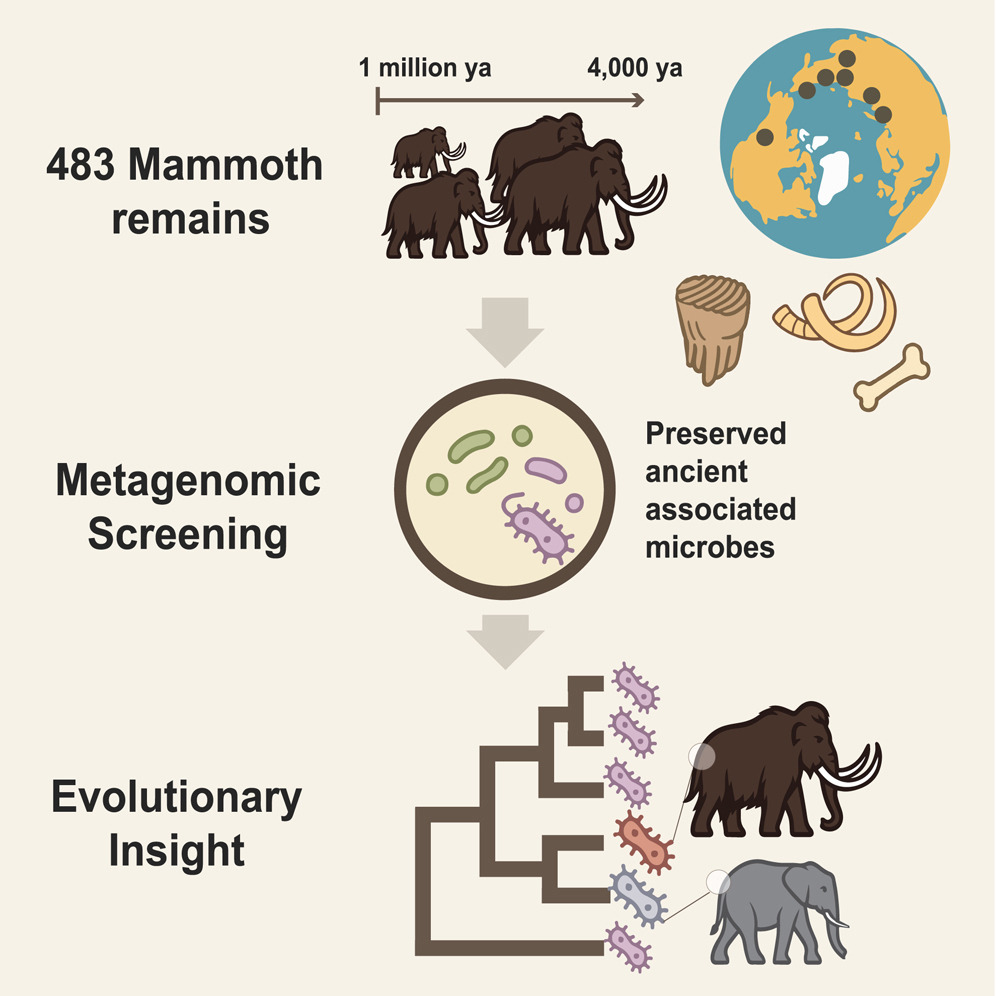
Researchers from the Center for Paleogenetics have led an international team that has discovered microbial DNA preserved in over a million-year-old woolly and steppe mammoth remnants. The findings reveal microbes that may have caused sickness in mammoths and uncover some of the oldest microbial DNA ever collected. The results are released in Cell.
Of the 483 mammoth specimens whose microbial DNA the researchers examined, 440 were sequenced for the first time. A steppe mammoth that existed about 1.1 million years ago was one of them. The scientists separated bacteria that originally coexisted with the mammoths from those that infiltrated their carcasses after they died by using sophisticated genomic and bioinformatic approaches.
Imagine having a mammoth tooth that is a million years old. What if it still contains remnants of the bacteria that coexisted with this mammoth in the past? The findings improve our understanding of microbial DNA by more than a million years, providing new possibilities for investigating how host-associated bacteria developed concurrently with their hosts.
Six microbial families, including relatives of Actinobacillus, Pasteurella, Streptococcus, and Erysipelothrix, were shown to be consistently linked to mammoth hosts. It’s possible that some of these microorganisms were harmful.
For example, a disease that has led to deadly outbreaks in African elephants is closely linked to one of the Pasteurella-related bacteria found in the research. Given that mammoths’ closest extant relatives are African and Asian elephants, these results raise the possibility that mammoths were susceptible to comparable illnesses.
In a remarkable discovery, the scientists recreated partial genomes of Erysipelothrix from a steppe mammoth that was 1.1 million years old. This is the oldest host-associated microbial DNA that has ever been retrieved. Researchers’ understanding of the relationships between ancient hosts and their microbiomes is stretched to its breaking point by this discovery.
Getting accurate DNA data over a million years was like tracing a trail that constantly recreating itself because bacteria change so quickly. The results demonstrate how biological information from ancient remains may be preserved that goes far beyond the host DNA, providing us with insights into the ways that bacteria influenced extinction, illness, and adaptation in Pleistocene ecosystems.
Sources:
Ancient Host-Associated Microbes obtained from Mammoth Remains, Cell. DOI: 10.1016/j.cell.2025.08.003. www.cell.com/cell/fulltext/S0092-8674(25)00917-1
Ancient mammoth remains yield the world’s oldest host-associated bacterial DNA. https://phys.org/news/2025-09-ancient-mammoth-yield-world-oldest.html
AI Disclosure Statement:
The Chromoscience uses AI-assisted tools to support the preparation and editing of science articles. Content is reviewed by the editor for clarity and consistency with the cited research before publication. Readers are encouraged to consult the original scientific publications for complete findings, methods, and limitations.



Leave a Reply