

Advertisements
Advertisements
Related Topics

- Polynoidae is a family of worms found in saltwater, and they are known as scale worms.
- The family Polynoidae has five branchiate genera namely Branchipolynoe, Branchinotogluma, Branchiplicatus, Peinaleopolynoe, and Thermopolynoe.
- All of the genera are native to deep-sea, chemosynthetic-based habitat.
- Branchiate organisms are animals furnished with gills.[2]
- Chemosynthetic habitat is an environment where sunlight is not able to reach and living organisms synthesize organic compounds from the reaction involving inorganic chemicals to get their energy.[3]
- Peinaleopolynoe has two known species namely Peinaleopolynoe sillardi and Peinaleopolynoe santacatalina.
- Researchers aimed to assess the phylogenetic position of Peinaleopolynoe by studying DNA sequences from a broad sampling of deep-sea polynoids.
- Several species from all five branchiate genera were used in the analyses.
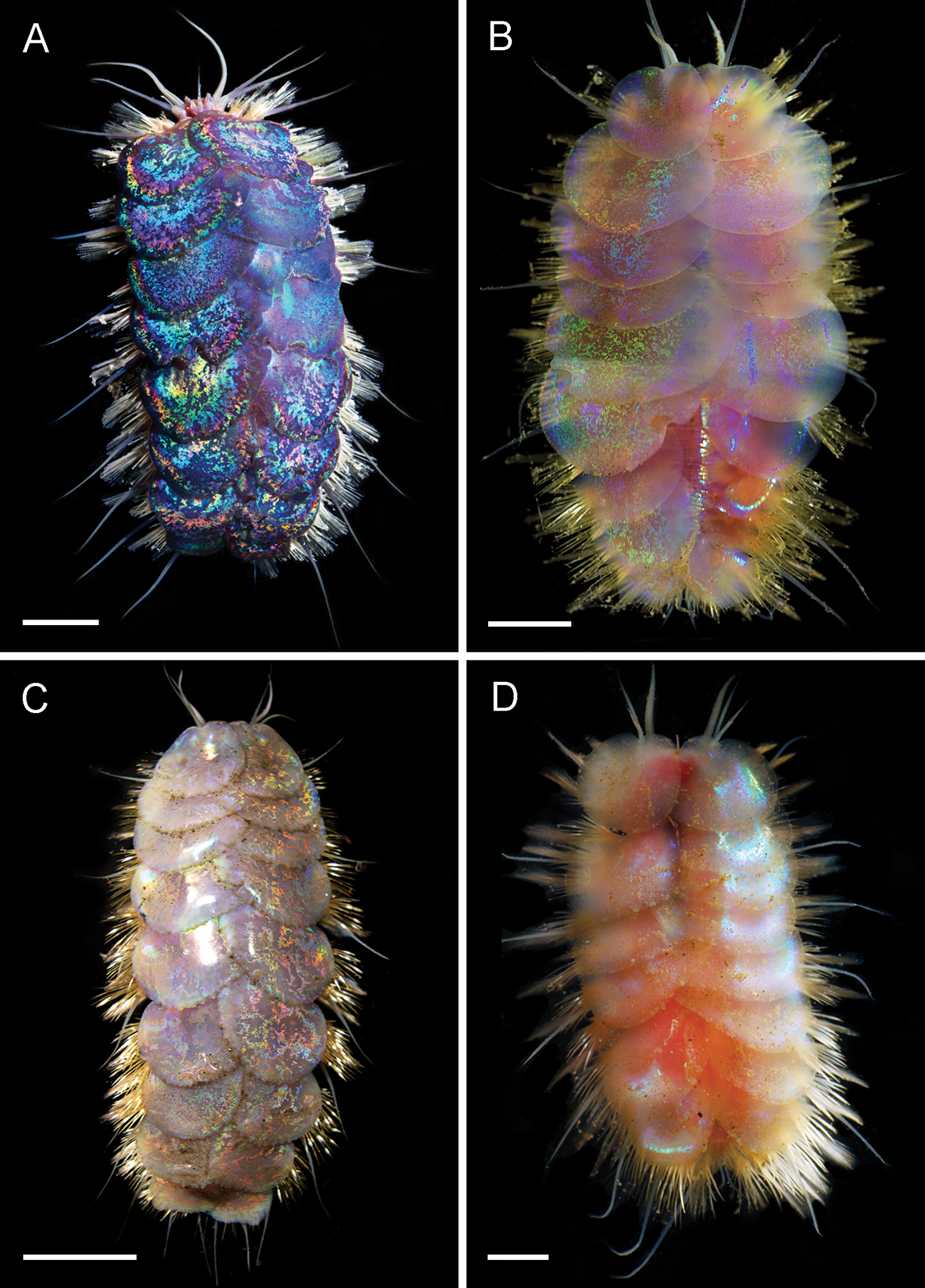
- Phylogenetic analyses revealed that four new species of Peinaleopolynoe from the Pacific Ocean have been discovered.
- The new deep-sea dwellers display iridescent scales which look like Elvis’ iconic jumpsuits hence, they named them Elvis worms.
- Additionally, researchers observed the presence of ventral papillae on segments 12-15 which reinforced the monophyletic groupings of Peinaleopolynoe.
- The results also demonstrated the paraphyletic groupings of Branchinotogluma and Lepidonotopodium and that these genera require taxonomic revision.
- Researchers apply the subfamily name Lepidonotopodinae for the clade comprised of Branchipolynoe, Branchinotogluma, Bathykurila, Branchiplicatus, Lepidonotopodium, Levensteiniella, Thermopolynoe, and Peinaleopolynoe.
- The researchers do not know why Elvis worms evolved to have such glittery scales since the organisms live in a very dark environment.
- They speculated that it could be just a side effect of developing thicker scales over time which refract more light.
- Researchers also said that thicker scales are advantageous when it comes to fighting and survival.
Sources:
Hatch AS, Liew H, Hourdez S, Rouse GW (2020) Hungry scale worms: Phylogenetics of Peinaleopolynoe (Polynoidae, Annelida), with four new species. ZooKeys 932: 27-74. https://doi.org/10.3897/zookeys.932.48532
https://www.sciencenews.org/article/deep-sea-worms-elvis-species
[2] https://www.merriam-webster.com/dictionary/branchiate
[3] Oxford Dictionaries
Advertisements
Advertisements
AI Disclosure Statement:
The Chromoscience uses AI-assisted tools to support the preparation and editing of science articles. Content is reviewed by the editor for clarity and consistency with the cited research before publication. Readers are encouraged to consult the original scientific publications for complete findings, methods, and limitations.



