

Advertisements
Advertisements
Related Topics

- Eunicid polychaetes have long, segmented bodies, and strong denticulated jaws.
- They are widely distributed in tropical to temperate shallow marine to shores.
- The “Bobbit worm” is one of the largest eunicids that fascinated the public.
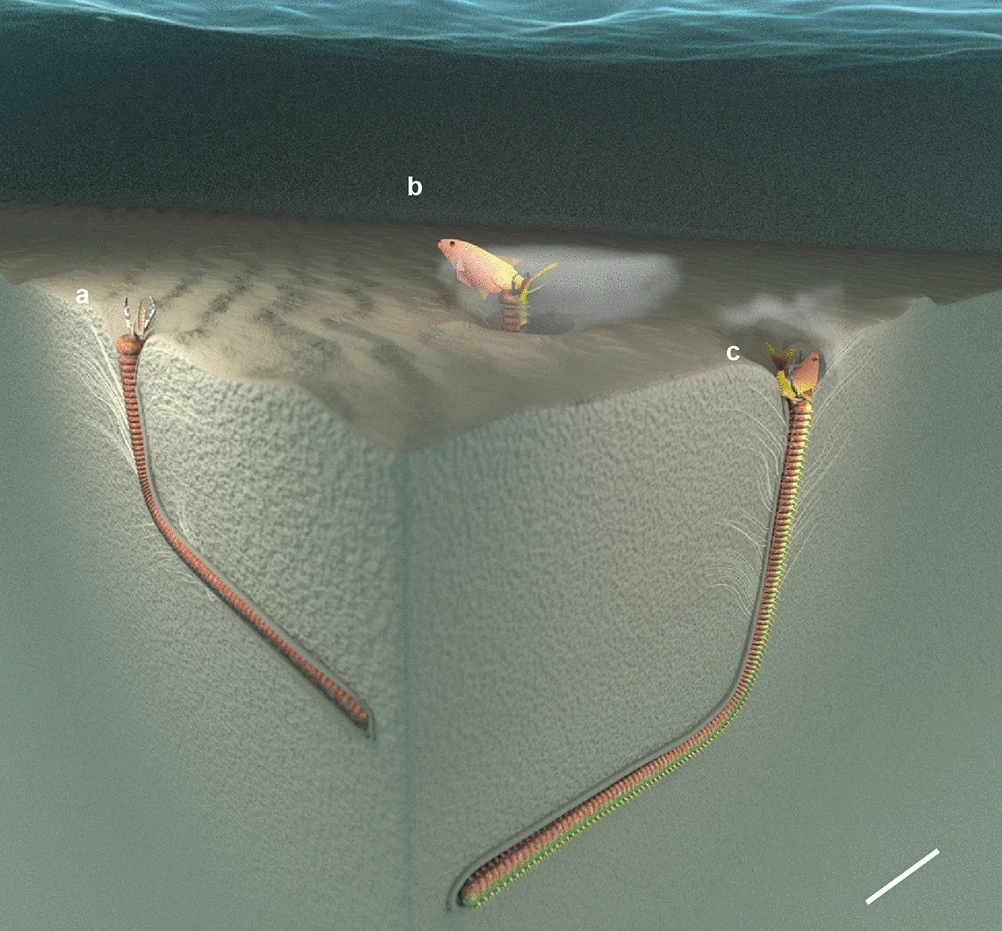
- Burrowing “Bobbit worm” only extend a minor portion of their body outside of the sediment, thus observations on their behavior beneath the seafloor are difficult.
- However, the feeding behavior of this giant ambush-predator is amazing.
- “Bobbit worm” hides in burrow and explodes upwards snatching unsuspecting preys with their powerful jaws.
- The preys are still alive when the “Bobbit worm” pulls them into the sediment for consumption.
- Ancient predatory polychaetes have soft-tissue bodies resulting in an incomplete fossil record.
- Nothing is known about the burrows and behavior beneath the seafloor of these ancient polychaetes.
- Researchers used data from Miocene strata in northeast Taiwan to erect a new ichnogenus, Pennichnus.
- Ichnogenus is a group of trace fossils that is given a name because the similarity of the traces suggests they were made by closely related species of organisms.[1]
- Fossil length: 2 meters long
- Fossil diameter: 2 to 3 centimeter
- Fossil shape: L-shaped burrow
- The fossil has distinct feather-like structures around the upper shaft.
- A comparison of Pennichnus to other biologically similar organisms strongly suggests that this new ichnogenus is related with ambush-predatory worms that lived about 20 million years ago.
Sources:
Pan, YY., Nara, M., Löwemark, L. et al. The 20-million-year old lair of an ambush-predatory worm preserved in northeast Taiwan. Sci Rep 11, 1174 (2021). https://doi.org/10.1038/s41598-020-79311-0
[1] https://www.encyclopedia.com/science/dictionaries-thesauruses-pictures-and-press-releases/ichnogenus
Advertisements
Advertisements
AI Disclosure Statement:
The Chromoscience uses AI-assisted tools to support the preparation and editing of science articles. Content is reviewed by the editor for clarity and consistency with the cited research before publication. Readers are encouraged to consult the original scientific publications for complete findings, methods, and limitations.



