

Related Topics

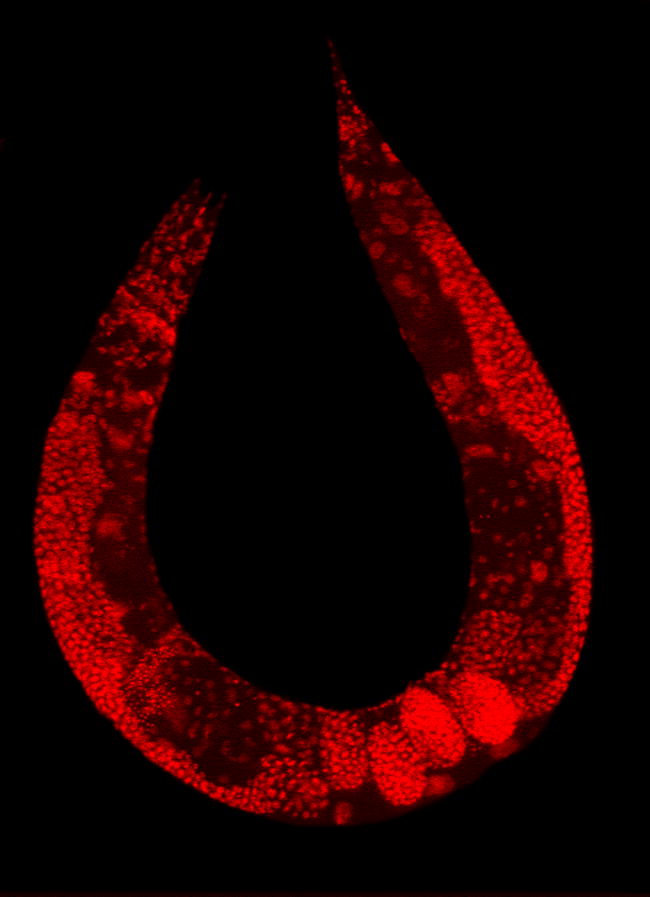
Simply seeing a dead counterpart produces powerful responses across species. For instance, bees and ants immediately eliminate dead hive members to avoid diseases. University of Michigan researchers found that C. elegans also dislikes the dead.
In the presence of dead members of their species, the worms reproduce faster and have shorter lives.
The scientists saw this as a great opportunity to study how C. elegans detects a deceased member and reacts to it.
The research group investigates how proteins maintain correct function as they age. C. elegans is good for investigating life and life extension due to its short lifespans.
Their new investigation was inspired by the fact that the worms would avoid dead ones. The team thought how the eyeless worms knew their plate-mates were dead and if dead individuals released a universal death signal.
They placed worm corpses or fluid from disintegrated worm cells in different feeding locations on a plate to test it. Both were strongly avoided by C. elegans. They also observed that death perception decreased worm survival and increased egg laying temporarily.
The research group then analyzed the worms’ sensory neurons to find out which were needed to perceive death. AWB and ASH neurons react to olfactory input, thus worms may smell death.
Two compounds, AMP and histidine, normally found inside cells, were C. elegans’ death signals.
The discovered neurons are known to respond to environmental signals behaviorally. Researchers have discovered two intracellular metabolites that are not present in nature. Having them signals a cell has perished, burst open, and something is not right.
Cellular metabolites in inappropriate locations may be an evolutionary indicator of death. According to a new study in humans, apoptotic cells emit chemicals that affect transcription in nearby tissue.
Further research is needed to determine how this signal affects health and behavior.
Sources:
Mirella A. Hernandez-Lima et al. (2025). Modulation of C. elegans behavior, fitness, and lifespan by AWB/ASH-dependent death perception, Current Biology. DOI: 10.1016/j.cub.2025.03.071
The scent of death? Worms experience altered fertility and lifespan when exposed to dead counterparts. https://phys.org/news/2025-05-scent-death-worms-fertility-lifespan.html
AI Disclosure Statement:
The Chromoscience uses AI-assisted tools to support the preparation and editing of science articles. Content is reviewed by the editor for clarity and consistency with the cited research before publication. Readers are encouraged to consult the original scientific publications for complete findings, methods, and limitations.



