

Related Topics

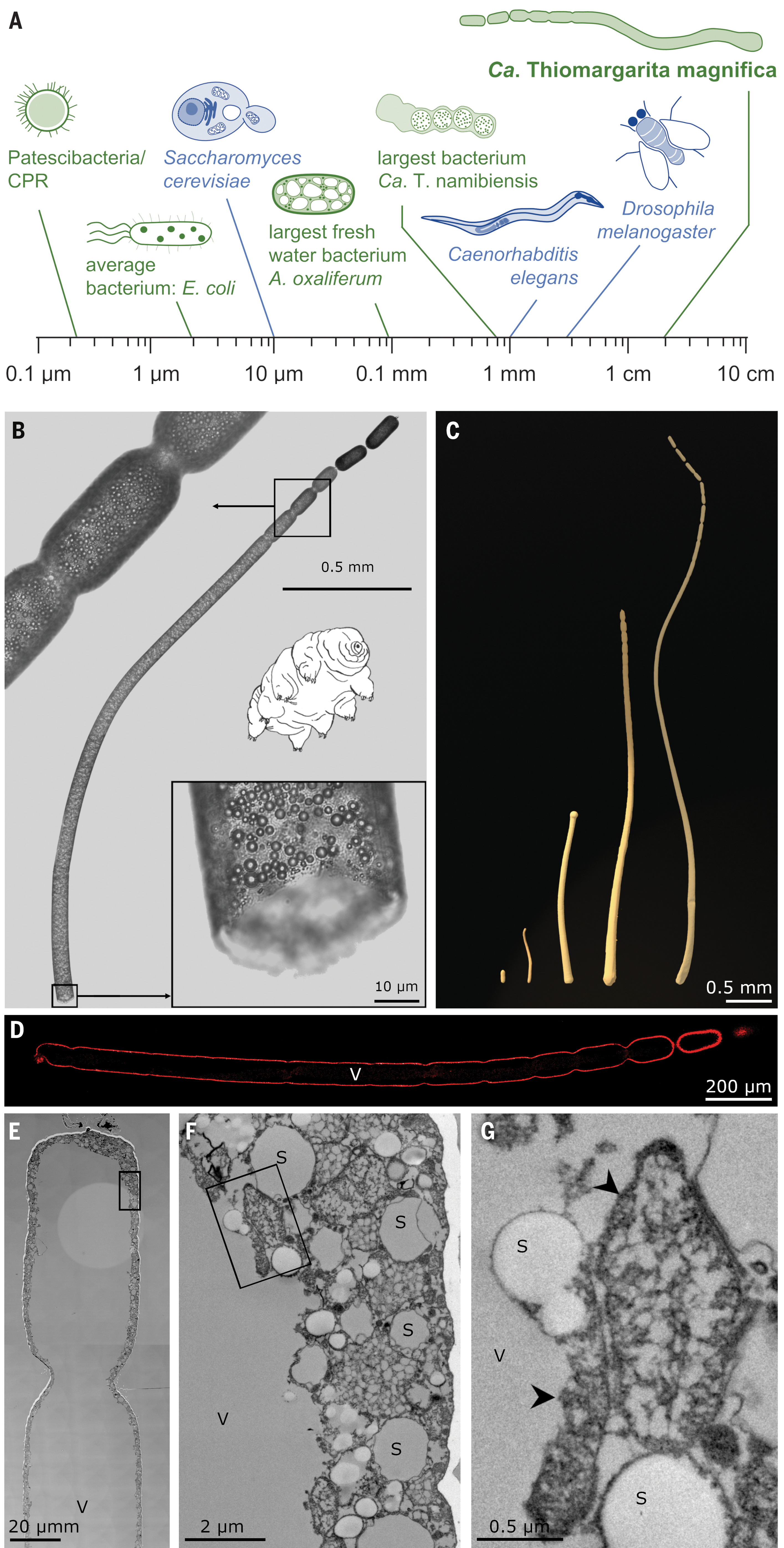
According to study published in the June 24 issue of Science, the newly discovered species, Thiomargarita magnifica, is about a centimeter long and has amazingly complex cells.
At a news conference on June 21, marine researcher Jean-Marie Volland of the Laboratory for Research in Complex Systems in Menlo Park, California, said that the bacterial giant is roughly the size and shape of a human eyelash. T. magnifica may grow to a maximum size of around 2 centimeters, which is about 5,000 times larger than the majority of other species of average-sized bacteria and about 50 times larger than other gigantic bacteria.
Additionally, T. magnifica packs its DNA into a sac that is enclosed by a membrane, in contrast to most bacteria, whose genetic material floats freely inside the cell. The larger, more complicated cells of eukaryotes, a class of creatures that includes plants and animals, are characterized by the presence of such a compartment.
When gathering water samples in tropical marine mangrove forests in the Lesser Antilles of the Caribbean, study coauthor and marine researcher Olivier Gros of the Université des Antilles Pointe-á-Pitre in Guadeloupe, France, first came across T. magnifica. According to Gros at the press conference, at first he thought the protracted, white filaments were some kind of eukaryote. Genetic tests, however, revealed a few years later that the organisms were truly bacteria. The cells’ DNA-containing sacs were visible when examined more closely under the microscope.
According to earlier research, the size of bacteria could only increase so much due to the general lack of complexity in bacterial cells. But according to Ferran Garcia-Pichel, a microbiologist from Arizona State University in Tempe who was not involved in the study, the new discovery is shattering their way of thinking about bacteria. People frequently consider bacteria as being little and straightforward. According to Garcia-Pichel, this perspective could cause researchers to overlook many more bacterial species. It’s comparable to believing that a little frog is the largest animal that has ever existed until scientists discover elephants.
What function T. magnifica serves amid the mangroves is still unknown. The reason it grew to be so big is also a mystery. According to Volland, it’s possible that being centimeters long facilitates cells’ access to the nutrients sulfide and oxygen that the bacteria require to survive.
Sources:
J. Volland et al. (2022). A centimeter-long bacterium with DNA contained in metabolically active, membrane-bound organelles. Science. Vol. 376 p. 1453. doi: 10.1126/science.abb3634.
AI Disclosure Statement:
The Chromoscience uses AI-assisted tools to support the preparation and editing of science articles. Content is reviewed by the editor for clarity and consistency with the cited research before publication. Readers are encouraged to consult the original scientific publications for complete findings, methods, and limitations.



