

Advertisements
Advertisements
Related Topics

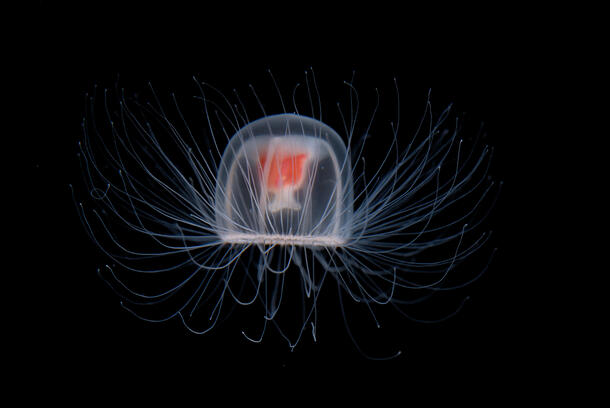
- Immortal jellyfish (Turritopsis dohrnii) has the ability to rejuvenate during its post-reproductive stage as a medusa.
- Medusa is the free-swimming form of a jellyfish at which the shape is like an umbrella with tentacles around the edges.
- The biological immortality of this jellyfish challenges our knowledge of aging.
- Researchers compared genomes of T. dohrnii (immortal) and T. rubra (mortal).
- Researchers identified genes associated with DNA repair, telomere, replication, redox environment, stem cell abundance, and communication between cells.
Advertisements
- Researchers found that the polycomb repressive complex 2 targets were silenced.
- Polycomb repressive complex 2 plays an important function during development, and it is responsible for maintaining the repressive states of many developmental genes.[1]
- Additionally, researchers found that pluripotency targets were activated.
- Pluripotency is ability of a cell to develop into the three primary germ cell layers namely ectoderm, mesoderm and endoderm.[2]
- The research highlights these factors as important elements in the ability of immortal jellyfish to undergo rejuvenation.
Sources:
Pascual-Torner, M., Carrero, D., Pérez-Silva, J. G., Álvarez-Puente, D., Roiz-Valle, D., Bretones, G., Rodríguez, D., Maeso, D., Mateo-González, E., Español, Y., Mariño, G., Acuña, J. L., Quesada, V., & López-Otín, C. (2022). Comparative genomics of mortal and immortal cnidarians unveils novel keys behind rejuvenation. Proceedings of the National Academy of Sciences of the United States of America, 119(36), e2118763119. https://doi.org/10.1073/pnas.2118763119
[2] https://www.nature.com/subjects/pluripotency



