
Related Topics

It has been discovered that Los Angeles and Orange counties have a previously undiscovered species that lives in the parks.
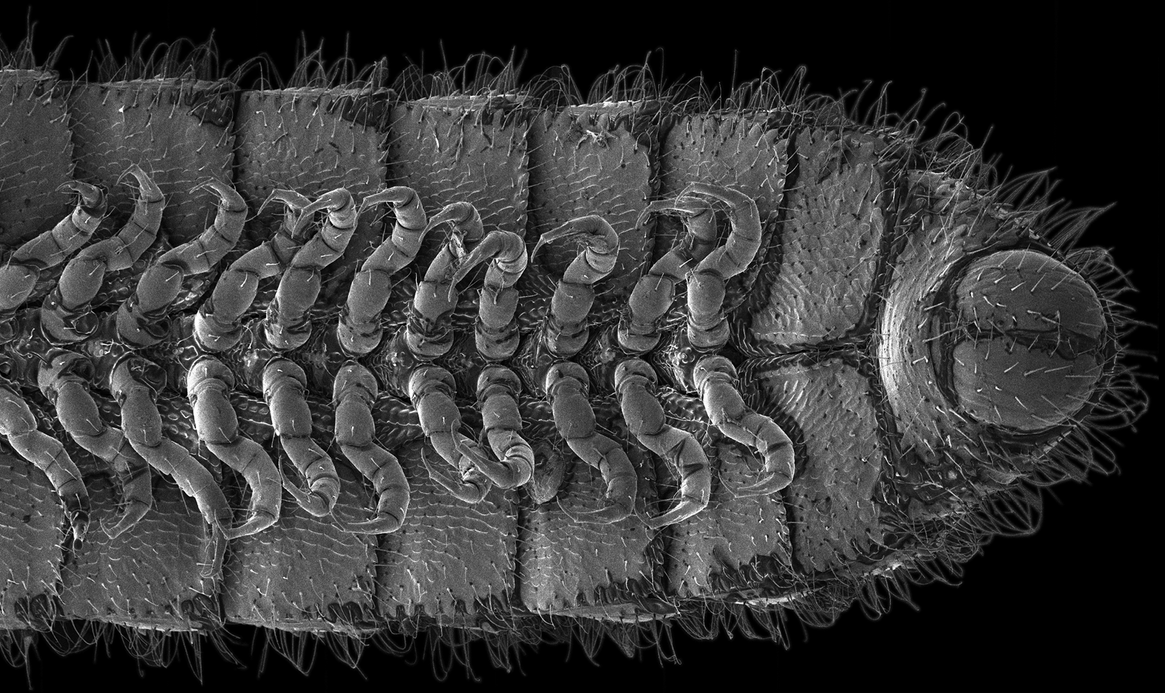
The creature’s head is reminiscent to a Predator’s, and it has 486 legs. It looks like a green glow-in-the-dark toy during the day and delicately threads its way through the earth like an embroidery needle.
When you remove the creature from the microscope, the Los Angeles thread millipede (Illacme socal) is much less frightening. This thread-like invertebrate has been overlooked up until now because it is so small, measuring only the width of a thin mechanical pencil lead and the length of a sewing pin.
The Los Angeles thread millipede has been formally introduced to the scientific community, joining the ranks of the about 12,000 other millipede species in the world.
This finding is a reminder of the massive kingdom of microscopic animals that form the foundation of the world’s ecosystems, a universe of organisms so little that we may lose them forever before we fully understand the essential function they play.
An entomologist from the Virginia Museum of Natural History who was not involved in the study, Derek Hennen, said these new species are right below our feet, literally.
Even in a densely populated area like Los Angeles, new species can be discovered in places where people may have simply not been searching. This highlights the need of protecting natural habitats and open green spaces.
The first sighting of the millipede was made by naturalists Cedric Lee and James Bailey in April of 2018 at Whiting Ranch Wilderness Park in the Lake Forest area. The two people looked at each other and simultaneously realized they were staring at something completely new.
Paul E. Marek, an entomologist at Virginia Tech, happened to be using the app at the same time and saw the finding. While in Los Angeles for the holidays with his family, Marek and his wife decided to take a trip out to Whiting Ranch in search of the same critter.
As arthropod invertebrates, millipedes are more closely related to crustaceans like lobsters and crabs than they are to insects. This group resembles plant root hairs in appearance and behavior, and they are small and sluggish. In the dirt, Marek and his wife looked for anything that was white, slender, and longer than 0.7 inches after carefully removing the mat of rocks, dead leaves, and humus.
Marek carefully put the specimens they found into plastic vials with a bit of soil and packed them in his carry-on for his trip back to his lab in Virginia. “They don’t seem to appear on an X-ray,” he added.
The millipede was verified to be a new species after its DNA was sequenced and its physical structures were examined closely. When Lee returned to California, he continued to observe the creature at the Eaton Canyon Natural Area near Pasadena. Lee and Bailey are both authors on the publication in ZooKeys that officially names the species.
Millipedes do the unglamorous but crucial task of removing dead matters from woods. They eat decaying plant materials and then excrete nutrients that can be used to reseed the soil.
According to Marek, these creatures seem to be like a little garbage men of the forest. They just kind of go around, eat trash, poop it out, and enhanced the soil.
Millipedes have existed nearly from the beginning of life on Earth’s surface. The fossil record suggests that these animals were the first on Earth to take in oxygen from the air.
They’re crucial, but their fragility makes them extremely risky: Most of them, like the Los Angeles thread, are blind and don’t sting or bite. At least they have a defense mechanism going for them in the form of compounds they secrete that make them taste terrible to birds, larger insects, and other predators.
Entomologists have noted that the finding of a new species in the soil of a rapidly growing city demonstrates how little we know about the smallest components of our ecosystem, whose habitats may be paved over before we realize what we’ve lost.
Curator of Entomology at the Natural History Museum of Los Angeles County Brian Brown said that it’s an appreciation of what’s out there, and an awareness of what we could lose. Those little things are essential and matter a lot.
Sources:
Paul E. Marek et al. (2023). A new species of Illacme from southern California (Siphonophorida, Siphonorhinidae), ZooKeys. DOI: 10.3897/zookeys.1167.102537
https://phys.org/news/2023-07-legged-creature-la-area.html
AI Disclosure Statement:
The Chromoscience uses AI-assisted tools to support the preparation and editing of science articles. Content is reviewed by the editor for clarity and consistency with the cited research before publication. Readers are encouraged to consult the original scientific publications for complete findings, methods, and limitations.