

Related Topics

The cell’s basic housekeeping mechanism, autophagy breaks down and recycles damaged organelles, proteins, and other components to avoid clutter. Maintaining cellular homeostasis depends on this essential function, which exists in all living entities including plants and animals as well as single-celled organisms. Its disturbance is related to several well-known human disorders like cancer, Parkinson’s, and Alzheimer’s.
Although from medical and biological aspects knowledge of autophagy in depth is crucial, it is not a one-size-fits-all event. Several types of autophagy vary in how the components to be broken down are carried to the lysosomes or vacuoles—the organelles that act as the waste disposal and recycling hub of the cell.
Autophagy affects a variety of intracellular components, such as a region of the nucleus that is responsible for the storage of critical chromosomes. The physiological relevance of autophagic breakdown of the nucleus is yet unknown, though.
A Japanese research team reportedly worked on an autophagy mechanism degrading a portion of the nucleus (macronucleophagy) in Saccharomyces cerevisiae, a type of yeast extensively utilized as a model organism in cellular investigation.
Published in Nature Communications, the researchers aimed to clarify how macronucleophagy guarantees the survival of nitrogen-starved S. cerevisiae and demonstrated that uncontrolled micronucleophagy resulting from the absence of normal macronucleophagy triggers cell death. Ph.D. candidate Ziyang Li of the Institute of Science Tokyo oversaw the project.
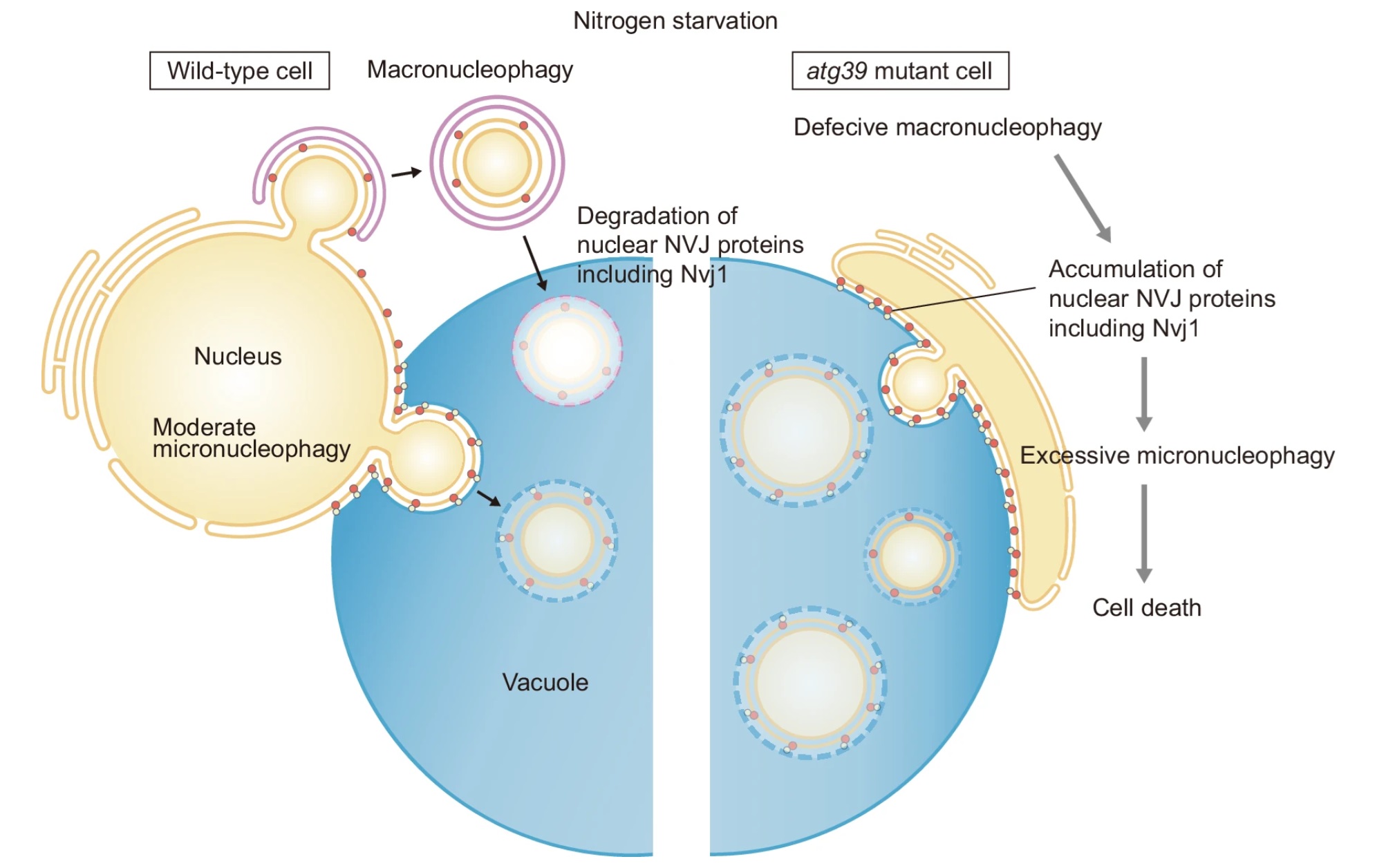
To put it another way, macronucleophagy is an autophagy process whereby a portion of the nucleus bulges outward, becomes enclosed by a vesicle known as autophagosome, and is delivered to the vacuole. In micronucleophagy the outer surface of the nucleus encounters the vacuole at nuclear-vacuole junctions (NVJs). Part of the nucleus moves into the vacuole (or invaginates), divides, and is eventually broken down under the control of particular nuclear and vacuolar membrane proteins.
In a past work, the team discovered that during nitrogen deprivation, mutant yeast cells with impaired macronucleophagy (atg39Δ mutants) died quickly. Following detailed comparisons of wild-type and atg39Δ cells, the researchers found that the mutants had very high micronucleophagy and that this hyperactivation was a main cause of cell death.
By means of further investigation, the scientists connected this hyperactivation to a nuclear surface protein named Nvj1, which is fundamental in the coupling of the nucleus and the vacuole at the NVJs. It turns out that macronucleophagy’s defects cause Nvj1 to accumulate in the nucleus, which significantly enhances micronucleophagy.
While increasing micronucleophagy aggravated cell death under nitrogen shortage, blocking micronucleophagy almost totally prevented cell death induced by the lack of macronucleophagy.
Conversely, these findings imply that macronucleophagy controls micronucleophagy to prevent the excess elimination of nuclear components, hence preserving nuclear and cellular homeostasis.
Put together, the results of this work clarify how closely various types of autophagy are linked, even to the extent of guiding cell survival under stress.
The researchers have shown that macronucleophagy depends critically on the control of micronucleophagy, which offers a physiological and mechanical connection between several autophagy processes.
More research on this intricate subject would enable us to better grasp how cells look after themselves, which would have significant consequences in biotechnology and medicine.
Sources:
Ziyang Li et al. (2024). Macronucleophagy maintains cell viability under nitrogen starvation by modulating micronucleophagy, Nature Communications. DOI: 10.1038/s41467-024-55045-9
https://phys.org/news/2025-01-macronucleophagy-survival-nitrogen-starved-yeast.html
AI Disclosure Statement:
The Chromoscience uses AI-assisted tools to support the preparation and editing of science articles. Content is reviewed by the editor for clarity and consistency with the cited research before publication. Readers are encouraged to consult the original scientific publications for complete findings, methods, and limitations.



