
Related Topics

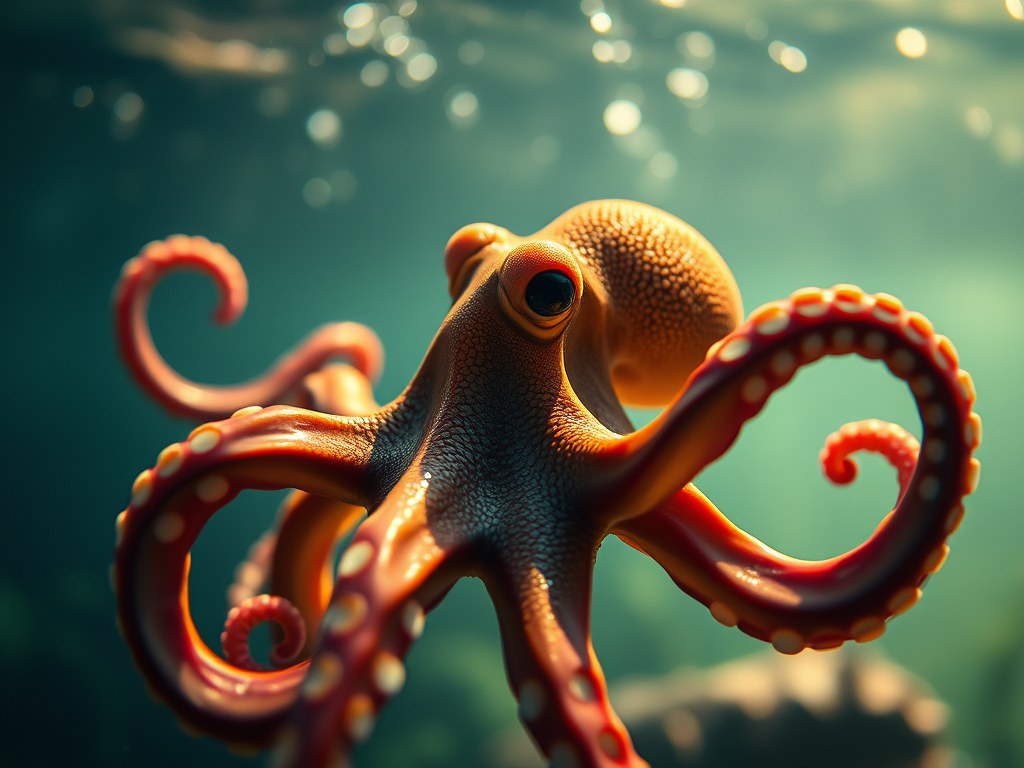
Cephalopods, which include octopus, squid, and their cousins the cuttlefish, exhibit some genuinely endearing habits. In order to blend in with their surroundings, they may quickly analyze information to change their shape, color, and even texture. They can also use tools to solve issues, communicate, and exhibit signs of spatial learning. They’re so intelligent that they may experience boredom.
It’s known that cephalopods have the most complicated brains of any invertebrate on the planet. The method of development, however, is still a mystery. Basically, researchers have long wondered how cephalopods acquire their large brains. Two-thirds of these soft-bodied creatures’ central processing tissue is devoted to studying their visual systems, and researchers in a Harvard lab think they’ve figured it out. They claim that the procedure seems very familiar.
Researchers from the FAS Center for Systems Biology describe how they employed a novel live-imaging technology to virtually observe neurons developing in the embryo in a study that was published in Current Biology. They were then able to follow those cells as the retina’s nervous system evolved. They were shocked by what they witnessed.
They observed that the neural stem cells behaved uncannily like the vertebrate neural stem cells when developing their nervous systems. It implies that despite their 500 million year separation, cephalopods and vertebrates are not only using similar mechanisms to create their large brains, but also the process and the way the cells act, divide, and are shaped may actually be the blueprint for the development of this type of nervous system.
“Our conclusions were surprising,” said Kristen Koenig, a John Harvard Distinguished Fellow and the study’s main author. The researchers said that much of what they know about the development of the brain in vertebrates has long been assumed to be exclusive to that lineage.
The researchers said that they were led to believe that these two independently evolved very enormous nervous systems are made up of the same mechanisms because of how comparable the processes are. This implies that the procedures and tools used by animals throughout development may be crucial for the evolution of large nervous systems.
The Koenig Lab researchers concentrated on the retina of a species of long-finned squid called Doryteuthis pealeii. The northwest Atlantic Ocean is home to a large population of squid, which can grow to be around a foot long. They have amazing huge heads and eyes when they’re embryos.
The scientists employed approaches that were previously used to investigate model species like fruit flies and zebrafish. To observe the behavior of individual cells, they developed specialized instruments and advanced microscopes that could capture high resolution photos every 10 minutes. To map and track the cells, the researchers marked them using fluorescent dyes.
The team was able to see how brain progenitor cells are arranged thanks to this live-imaging approach. A pseudostratified epithelium is a unique kind of structure made up of the cells. The cells are elongated so they can be packed tightly, which is its fundamental characteristic. The nucleus of these structures was also observed by the researchers to travel up and down both before and after splitting. They claimed that this mobility is crucial for maintaining tissue organization and supporting ongoing growth.
The development of the brain and eyes in vertebrate species follows a pattern that is universal. It was once believed to be one of the factors that allowed the vertebrate nervous system to become so expansive and sophisticated. This form of neural epithelium has been seen in other animals, but the squid tissue studied in this case was unusually identical to vertebrate tissues in terms of size, structure, and nucleus movement.
The researchers will then investigate how various cell types develop in cephalopod brains. Koenig wants to know whether they express at different times, how they choose which sort of neuron to become, and whether this process is the same in different animals.
Koenig is enthusiastic about the upcoming discoveries which may be made.
One of the main lessons from this kind of research, according to Koenig, is how important it is to understand the variety of life. They said that you may actually get back to core concepts about even our own development and our own biomedically relevant concerns by examining this diversity.
Sources:
https://phys.org/news/2022-11-squid-octopus-big-brains.html
Francesca R. Napoli et al. (2022). Cephalopod retinal development shows vertebrate-like mechanisms of neurogenesis, Current Biology. DOI: 10.1016/j.cub.2022.10.027
AI Disclosure Statement:
The Chromoscience uses AI-assisted tools to support the preparation and editing of science articles. Content is reviewed by the editor for clarity and consistency with the cited research before publication. Readers are encouraged to consult the original scientific publications for complete findings, methods, and limitations.