
Related Topics

Researchers found a “guard mechanism” for a protein that attacks bacteria in infected cells, suggesting new treatments for infectious diseases and cancer.
A University of Birmingham study published in Science found the attack protein GPB1’s lock and key mechanism. Inflammation activates GBP1, which can damage membranes within cells.
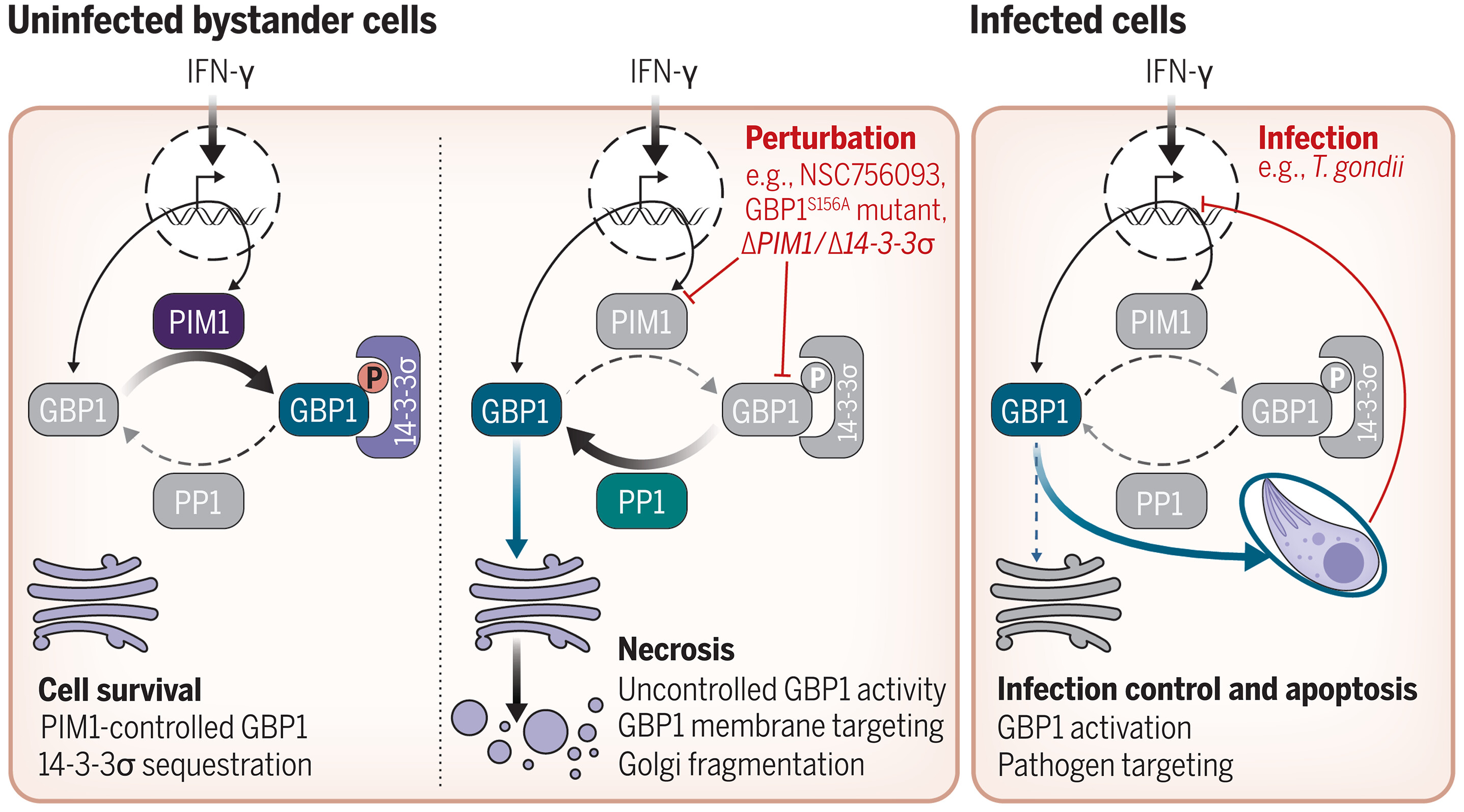
Protein kinases add phosphate groups to proteins, which controls the attack protein, according to the research. The GBP1-targeting kinase PIM1 can be induced during inflammation. Uninfected bystander cells are protected from GBP1 membrane attack and cell death by phosphorylated GBP1 linked to a scaffold protein.
The newly found method prevents GPB1 from randomly attacking cell membranes, creating a guard mechanism sensitive to pathogen activities inside cells. Daniel Fisch, a former Frickel lab Ph.D. student, discovered the finding.
Dr. Daniel Fisch commented that the six-year effort with multiple international research organizations was great. This would not have been possible without their colleagues and friends at The Francis Crick Institute in London, EMBL in Grenoble (France), ETH Zurich (Switzerland), and Osaka University (Japan).
According to study lead Dr. Eva Frickel, Senior Wellcome Trust Fellow at Birmingham University, the result is crucial for multiple reasons. The guard mechanism that controls GBP1 was known in plant biology but not in mammals. Imagine a lock-and-key system. GPB1 tries to attack cellular membranes, but PIM1 locks it up.
The second reason is that this finding may have various therapeutic uses. After understanding GBP1’s regulation, researchers can find ways to turn it on and off to kill infections.
This research was done by Dr. Frickel and her team on Toxoplasma gondii, a common cat parasite. Toxoplasma infections in Europe and Western countries rarely cause serious illness, but in South America they can cause recurrent eye infections and blindness, especially in pregnant women.
GBP1 attacks the parasite because Toxoplasma suppresses inflammatory signals in cells, inhibiting PIM1 production and releasing the “lock and key” system. GPB1 also attacked Toxoplasma and removed contaminated cells by turning PIM1 “off” via an inhibitor or genome manipulation.
Dr. Frickel added that the mechanism could also work on other pathogens, such as Chlamydia, Mycobacterium tuberculosis, and Staphylococcus, all major disease-causing pathogens that are becoming antibiotic-resistant.
The researchers could kill infections with the attack protein by manipulating the guard mechanism. They are currently considering the option to reproduce the Toxoplasma investigations. How this could attack cancer cells excites them too.
GPB1 is induced by cancer inflammation, while PIM1 helps cancer cells survive. Researchers believe they can kill cancer cells by disrupting PIM1-GPB1 interaction.
The impact on cancer treatment is tremendous, said Dr. Frickel. The researchers believe this guard mechanism is active in cancer cells, therefore they want to disrupt it and specifically kill them. They utilized a market inhibitor to disrupt PIM1-GPB1 interaction. This medicine could liberate GPB1 and attack cancer cells if it works. The identification of the PIM1 defense mechanism could represent a major step toward treating cancer and antibiotic-resistant bacteria.
Sources:
Daniel Fisch et al. (2023). PIM1 controls GBP1 activity to limit self-damage and to guard against pathogen infection, Science. DOI: 10.1126/science.adg2253. www.science.org/doi/10.1126/science.adg2253
Keywords: infectious diseases, cancer treatment
AI Disclosure Statement:
The Chromoscience uses AI-assisted tools to support the preparation and editing of science articles. Content is reviewed by the editor for clarity and consistency with the cited research before publication. Readers are encouraged to consult the original scientific publications for complete findings, methods, and limitations.