
Related Topics

A lot of us think of sharks as big, strong prime hunters that catch their food swiftly and with strength. Some sharks do things differently, like mako, great white, and bull sharks.
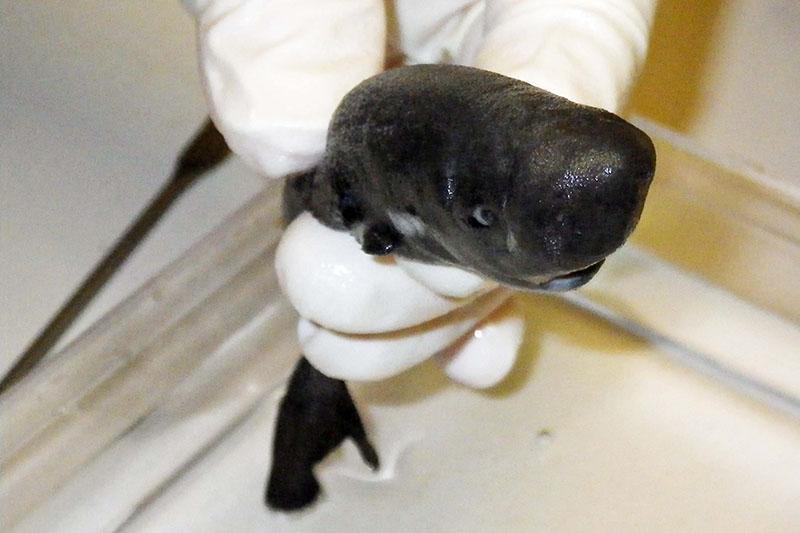
Mollisquama mississippiensis, the American pocket shark that was just found, has a clever way of getting its prey. The 5-½-inch-long shark releases a glowing substance to attract its food, a strategy similar to what deep-sea anglerfish do.
Scientists have only found two pocket sharks so far. This new one was found in the Gulf of Mexico in February 2010 but wasn’t officially named until just now. M. parini, the other species, was found in the Pacific in the late 1970s. Both of them are very rare. The two species have different numbers of vertebrae and distinct components of their bodies which emit light.
What gives this glowing elasmobranch its light? The shark have bioluminescent fluid that comes out of glands under their pectoral fins when they are hunting. Many sea creatures, like fish, plankton, jellyfish, and more, can bioluminescent, which means they make light through a chemical process. In the case of the American pocket shark, it can be used to draw prey or to find a mate and scare off attackers.
It’s important to protect the Gulf of Mexico so that the creatures we know and the ones we haven’t found yet can live on. Scientists have only found one pocket shark in the Gulf. This shows how little we know about the Gulf, especially its deeper waters, and how many more new species are still waiting to be found there.
Sources:
Grace, Mark & Doosey, Michael & DENTON, JOHN & Naylor, Gavin & Bart, Henry & Maisey, John. (2019). A new Western North Atlantic Ocean kitefin shark (Squaliformes: Dalatiidae) from the Gulf of Mexico. Zootaxa. 4619. 109-120. 10.11646/zootaxa.4619.1.4.
Meet This Tiny, Glow-in-the-Dark Shark. https://oceanconservancy.org/blog/2019/07/30/american-pocket-glow-shark
AI Disclosure Statement:
The Chromoscience uses AI-assisted tools to support the preparation and editing of science articles. Content is reviewed by the editor for clarity and consistency with the cited research before publication. Readers are encouraged to consult the original scientific publications for complete findings, methods, and limitations.