
Advertisements
Advertisements
Related Topics

- Global warming is the greatest threat to coral reefs.
- Projects about coral restoration have expanded around the world to replenish habitats with corals affected by different stressors.
- However, these restoration efforts will be of no use if outplanted corals cannot withstand the warmer oceans and high-temperature events.
- Stress hardening is one of the approaches to increase the temperature tolerance of corals currently grown for restoration.
- Scientific evidence suggests that environments with varying temperatures can reduce coral bleaching during exposure to thermal stress.
- However, it is still unclear if this localized adaption to varying temperatures can be used to enhance coral restoration efforts.
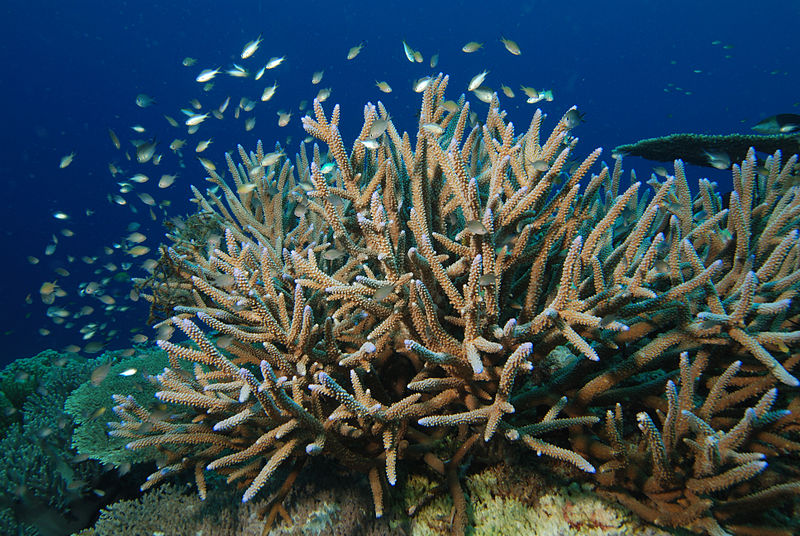
- Researchers treated fragments of Caribbean staghorn coral with variable and static temperatures in the laboratory for 89 days.
- The variable temperatures oscillated two times per day from 28 °C to 31 °C, while the static temperature was set to 28 °C.
- The fragments were then exposed to heat stress at 32 °C for 2 weeks.
- Corals in the variable temperatures showed signs of severe thermal stress later than corals in the static temperature and untreated field controls.
- Additionally, corals in the field control groups showed a higher incidence of tissue degradation while corals in the variable temperatures give way to bleaching at a slower pace.
- The study highlights the importance of variable temperature exposure to improve thermal tolerance of corals.
- The discovery will be important for future research and restoration of corals affected by climate change.
Source:
DeMerlis, A., Kirkland, A., Kaufman, M.L. et al. Pre-exposure to a variable temperature treatment improves the response of Acropora cervicornis to acute thermal stress. Coral Reefs (2022). https://doi.org/10.1007/s00338-022-02232-z
Advertisements
Advertisements
AI Disclosure Statement:
The Chromoscience uses AI-assisted tools to support the preparation and editing of science articles. Content is reviewed by the editor for clarity and consistency with the cited research before publication. Readers are encouraged to consult the original scientific publications for complete findings, methods, and limitations.