

Advertisements
Advertisements
Related Topics

- Malaria is a mosquito-borne disease caused by a parasite.
- People with malaria often experience fever, chills, and flu-like illness.
- Malaria is caused by single-celled microorganisms of the Plasmodium group.
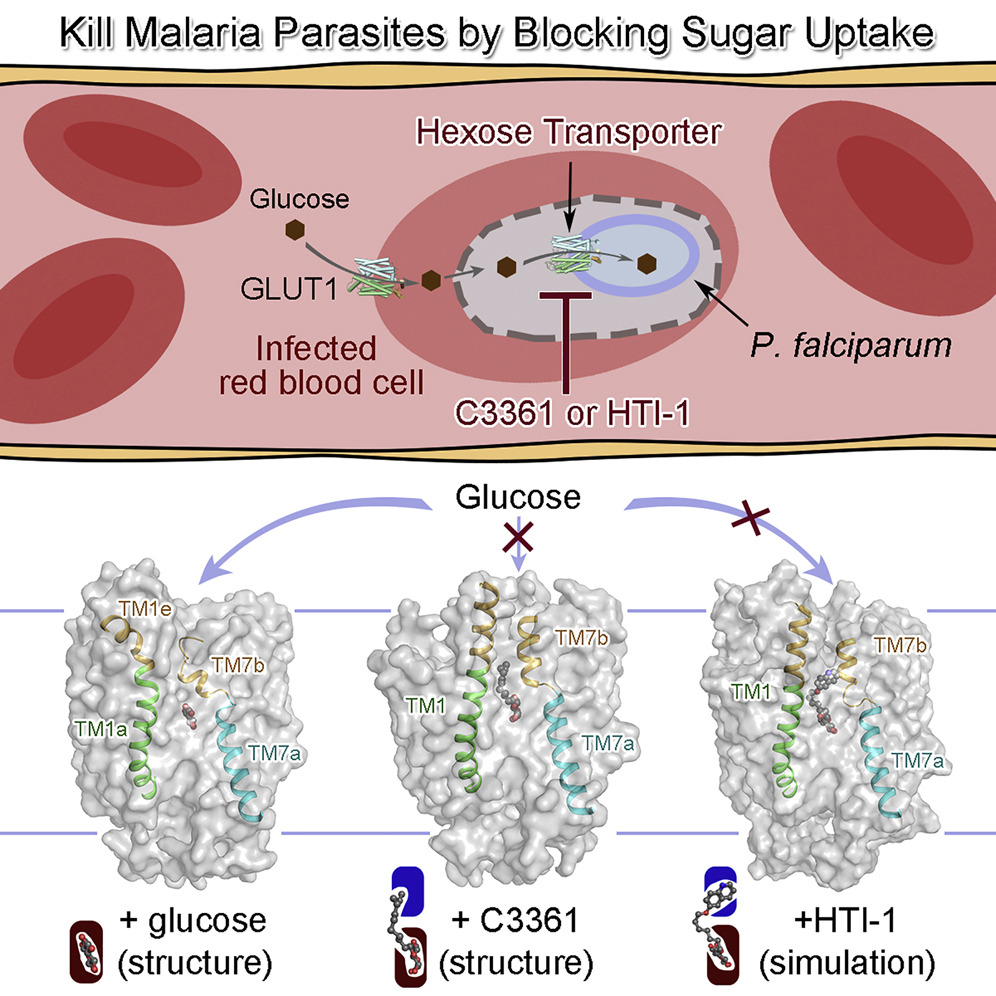
- Plasmodium species rely on glucose for energy supply during blood stage.
- Cutting the glucose uptake is a potential strategy for the development of antimalarial drugs.
- Plasmodium has a protein that transports glucose, and this protein is known to be essential for parasite growth and survival.
- In another study, compound 3361 (C3361) has been described to moderately inhibits this glucose transporter protein and suppresses the growth of the blood-stage parasites.
- This study present the crystal structures of the glucose transporter protein in complex with D-glucose and with the selective inhibitor C3361.
- Although both structures were blocked, binding of C3361 causes marked rearrangements that result in an additional pocket.
- This inhibitor-binding-induced pocket presents an opportunity for the rational design of the glucose transporter protein inhibitors.
- Among the designed C3361 derivatives, several exhibited improved inhibition of glucose transporter protein and cellular potency against the parasite with excellent selectivity to human GLUT1.
- GLUT1 facilitates the transport of glucose across the plasma membranes of mammalian cells.
- The findings serve as a proof of concept for the development of the next-generation antimalarial chemotherapeutics by simultaneously targeting the primary binding site and allosteric sites of the glucose transporter protein.
Sources:
https://doi.org/10.1016/j.cell.2020.08.015
https://www.cdc.gov/parasites/malaria/index.html
“Malaria Fact sheet N°94”. WHO. March 2014. Archived from the original on 3 September 2014. Retrieved 28 August 2014.
https://pubmed.ncbi.nlm.nih.gov/26248369/
https://www.biorxiv.org/content/10.1101/2020.08.25.260232v1.full
Olson AL, Pessin JE (1996). “Structure, function, and regulation of the mammalian facilitative glucose transporter gene family”. Annual Review of Nutrition. 16: 235–56. doi:10.1146/annurev.nu.16.070196.001315. PMID 8839927
Advertisements
Advertisements
AI Disclosure Statement:
The Chromoscience uses AI-assisted tools to support the preparation and editing of science articles. Content is reviewed by the editor for clarity and consistency with the cited research before publication. Readers are encouraged to consult the original scientific publications for complete findings, methods, and limitations.



