
Related Topics

Researchers from Leiden University have found an enzyme that assists bacteria in feeding on common daily plastics. This ubiquitous enzyme has the potential to play a significant part in future research and, ultimately, in finding a solution to the problem of plastic use all over the world. A publication of the work may be found in Nature Communications.
The discovery of bacteria that are capable of degrading plastics was made by scientists around ten years ago. It was a significant event. Up until that point, it was believed that plastic was almost impossible to destroy in a natural setting, and as a result, it was expected that it would remain in the natural environment for millions of years. When it came to breaking down plastics, the bacteria were, without a doubt, pretty sluggish and not very effective and efficient. However, it turned out that the finding was a beginning point for academics who were attempting to speed up this natural process for themselves.
A number of experts are concentrating their efforts on using bacteria to break down the plastic PET into its fundamental components. As a material, PET is often used in the manufacturing of food and beverage containers. Some people are interested in the subsequent stage of the process, which involves the transformation of these PET components into products that may actually be used in the production of new materials. To reiterate, with the assistance of bacteria.
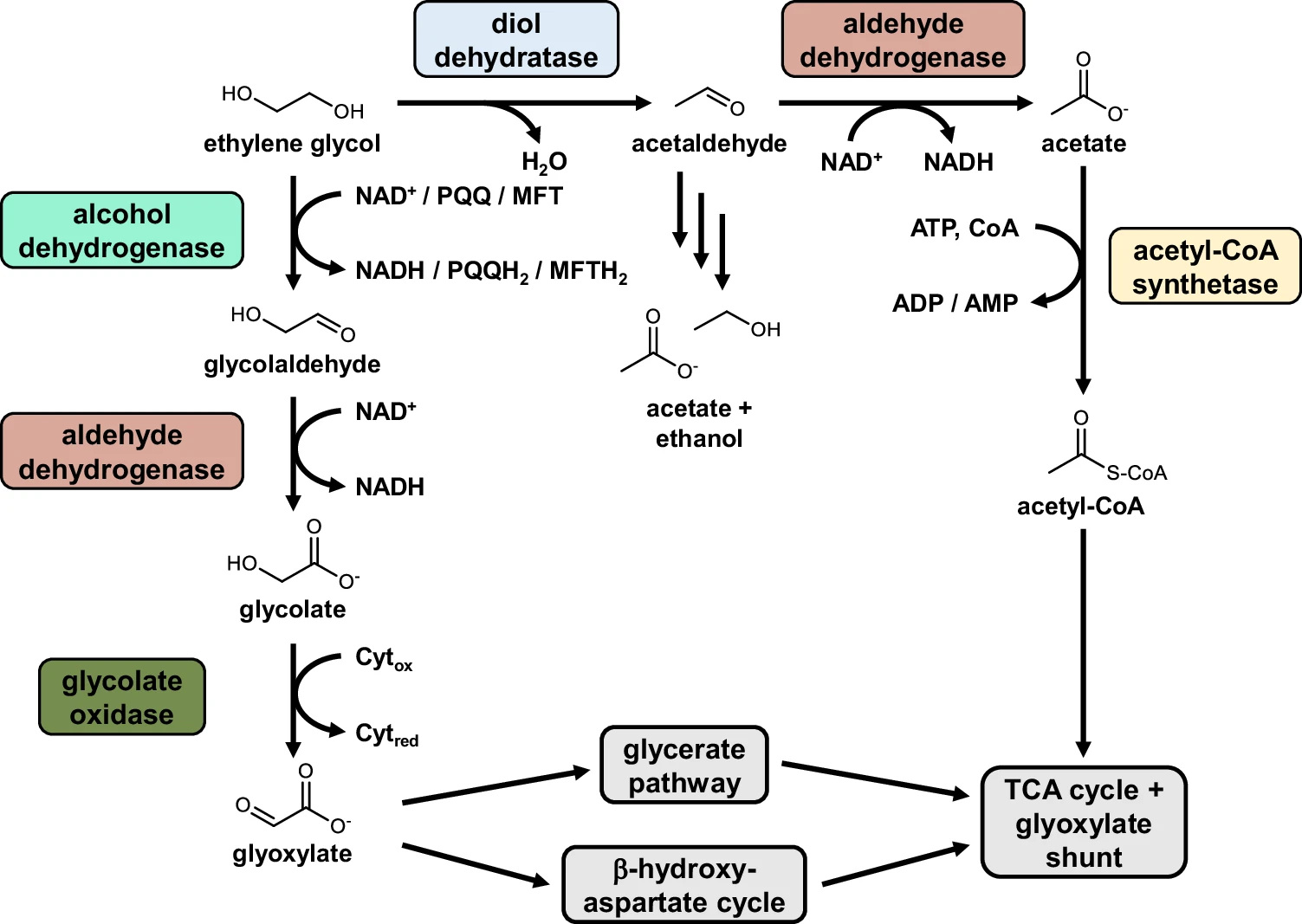
The researchers investigated the process by which a bacteria known as Paracoccus denitrificans might grow by using ethylene glycol. PET plastic is a source of ethylene glycol. They focused their attention primarily on the function that enzymes play in this process. These proteins contribute to the acceleration of chemical processes that occur in living organisms.
An analogy illustrates this procedure. Most people know ethanol from beer and wine. Drinking beer makes the body recognize ethanol as dangerous and transform it into safer substances. Enzymes do this. Each enzyme has a cofactor, or “helper molecule.”
The bacteria “consume” ethylene glycol via enzymes and cofactors. Adding the bacteria to ethylene glycol allowed the researchers to see its reaction. Indeed, the bacteria flourished pretty effectively.
One key result was that Paracoccus denitrificans used enzymes with a common cofactor. Other enzymes have been investigated, but these required a rare cofactor. A readily available cofactor simplifies this process.
This finding makes it possible to do more study in the future. The experts say it’s likely that this enzyme is also found in a lot of other bacteria. We can now look at every bacteria that are out there again. It was helpful to use Paracoccus denitrificans in this study, but other kinds of bacteria may still be more effective at transforming ethylene glycol.
This discovery is what the researchers call “a steppingstone” for more work to come. In theory, you could make any chemical you wanted from ethylene glycol, which is a part of plastic. As long as you can change the bacteria’s genes to make them do this. They make it clear that the study only looked at what bacteria do “naturally,” but theoretically, there are a lot of other things that could happen.
For example, scientists in Scotland were able to use a bacterium that they modified to turn PET elements into paracetamol. This shows that this method could be useful in the future, especially since plastic waste is getting worse and there is a push for a circular economy around the world.
Sources:
Minrui Ren et al. (2025). NAD-dependent dehydrogenases enable efficient growth of Paracoccus denitrificans on the PET monomer ethylene glycol, Nature Communications. DOI: 10.1038/s41467-025-61056-x
Newly discovered enzyme could play crucial role in bacterial breakdown of plastics. https://phys.org/news/2025-07-newly-enzyme-play-crucial-role.html
AI Disclosure Statement:
The Chromoscience uses AI-assisted tools to support the preparation and editing of science articles. Content is reviewed by the editor for clarity and consistency with the cited research before publication. Readers are encouraged to consult the original scientific publications for complete findings, methods, and limitations.