
Related Topics

A beneficial and essential component of the body is fat. Fat cells perform important functions in immunity, hormone regulation, and energy storage and release.
Scientific interest in the biology and chemistry of fat has increased recently due to a troubling rise in metabolic diseases like cardiovascular disease, high blood pressure, and diabetes, which has led to an abundance of knowledge about how fat cells function.
However, fat cells and their metabolic processes only tell part of the story.
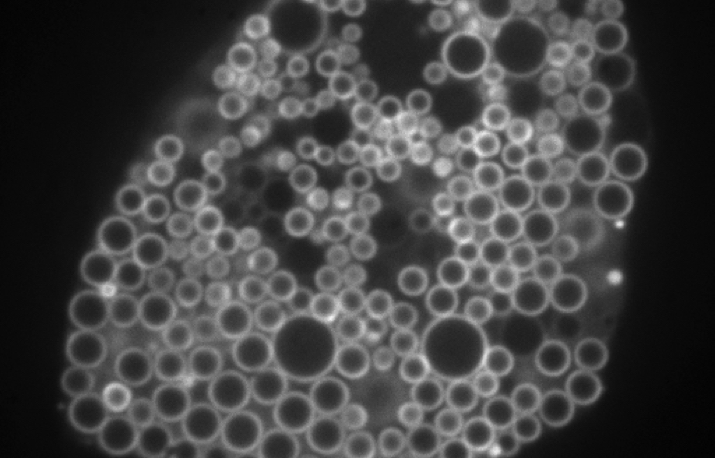
Scientific interest in fat-filled lipid droplets, which are tiny spheres of fat hundreds of times smaller than fat cells, is expanding. These lipid particles, which are present inside numerous distinct cell types, have long been poorly understood. Studies have started to shed light on these droplets’ involvement in cellular defense and metabolic processes, but we still know very little about the physical makeup of fat.
Developing study on the physics of these droplets has now been published by researchers at the University of Pennsylvania School of Engineering and Applied Science, exposing them to be a possible danger to a cell’s nucleus. Their investigation went beyond biochemistry. They are the ones to make the astonishing discovery that fat-filled lipid droplets can indent and rupture the nucleus, the organelle that houses and controls a cell’s DNA. The study was published in the August issue of the Journal of Cell Biology.
Their conclusions carry significant risk: A nucleus rupture can result in increased DNA damage, which is a hallmark of many illnesses, including cancer.
The study’s main investigators were Michael Tobin, a Ph.D. candidate in the Department of Bioengineering, Irena Ivanovska, a Ph.D. Research Associate in Penn’s Molecular and Cell Biophysics Lab, and Dennis E. Discher, Robert D. Bent Professor in the Department of Chemical and Biomolecular Engineering.
People naturally associate fat with softness, according to Discher. Yes, it is at the cellular level. However, it ceases being soft at this tiny droplet size—measuring only a few microns as opposed to the hundreds of microns of a mature fat cell. Its shape has a significantly sharper bend than other things because of its higher curvature. Its physics in the cell are altered by this. It can alter. It can damage. It can break.
The researchers explain, consider trying to pop a balloon with your fist. Impossible. The balloon won’t be ruptured, but you can deform it. Imagine attempting to pop it now using a pencil. That is how a fat cell differs from a cell that contains little fat droplets in the body. It’s not a metabolic difference; it’s a fundamental physical one.
The team’s discovery redefines the way scientists think about fat, highlighting the fact that fat serves many different functions in the body other than just adding weight.
This is about how fat affects biological components physically, even at the DNA level, and operates at scales smaller than a cell.
The team’s finding draws on a decade’s worth of fundamental investigation into the functions of nuclear proteins that give the nucleus its protective structural properties. These dynamic proteins give the nucleus what it needs to keep its integrity by changing levels in response to their mechanical surroundings.
In cells, there is a continuous process of DNA damage repair, according to Ivanovska. The nucleus must have enough DNA repair proteins for this to occur. These proteins disperse and are unable to quickly repair damages if a nucleus is ruptured. This leads to a buildup of DNA damage and may produce cancerous cells.
A cell’s physical and mechanical environment is dynamic, and mistakes can and do happen there. However, it also has an army of molecular assistants who are always trying to maintain and fix it.
The researchers said that the issue arises when a nucleus is compromised—by toxic substances, excessive exposure to UV radiation, or these lipid droplets containing fat. The risk of DNA damage is then very high, and this has an impact on one’s health.
Sources:
Irena L. Ivanovska et al. (2023). Small lipid droplets are rigid enough to indent a nucleus, dilute the lamina, and cause rupture, Journal of Cell Biology. DOI: 10.1083/jcb.202208123
AI Disclosure Statement:
The Chromoscience uses AI-assisted tools to support the preparation and editing of science articles. Content is reviewed by the editor for clarity and consistency with the cited research before publication. Readers are encouraged to consult the original scientific publications for complete findings, methods, and limitations.
Keywords: fat droplets, fat cells