

Advertisements
Advertisements
Related Topics

- Dolichomitus is a genus of Darwin wasps with large bodies, long ovipositors, and intense colors.
- The ovipositor is a female tubular organ used to deposit or lay eggs.[1]
- The genus includes more than 75 species globally and 20 can be found in the Neotropics.
- Neotropic is the region comprising of Central and South America which includes the tropical southern part of Mexico and the Caribbean.[2]
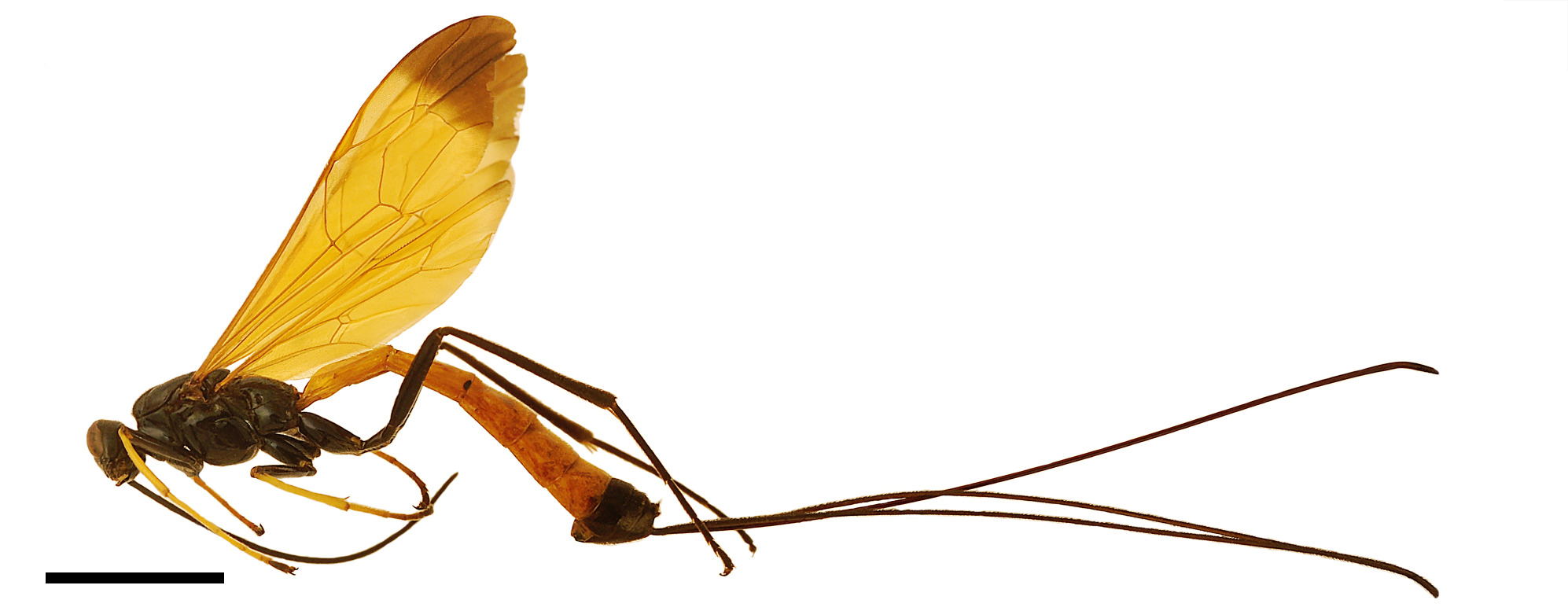
- The new species named Dolichomitus meii was discovered in Yanayacu located on the Andes slopes of Ecuador.
- Dr. Diego Pádua of the Instituto Nacional de Pesquisas da Amazonia said that the new species show what interesting surprises the Earth’s rainforests can have.
- The new species is interesting due to its large size and distinct coloring.
- The wasp’s body looks black with a quick glance however, with light, its color turns glittering electric blue.
- Additionally, its wings are golden yellow thus, the wasp is like a flying gem.
- This genus of wasps is usually parasitic on insect larvae that are found deep in the trunks of trees.
- They lay one egg on insect larvae and the young wasp consumes the host larva from the inside as it undergoes development.
- Professor Ilari Sääksjärvi of the University of Turku said that the ovipositor of Dolichomitus meii is very long.
- The wasp sticks its ovipositor through a hole in the wood and attempts to find host larvae.
- Researchers said that the distinct colors of the wasp act as a protection from birds that eat insects.
- Birds do not eat the wasp sitting on a tree trunk because they think it does not taste good or that it is dangerous to eat.
Sources:
https://bdj.pensoft.net/article/67438
http://www.sci-news.com/biology/dolichomitus-meii-09823.html
[1] https://en.wikipedia.org/wiki/Ovipositor
[2] Oxford Dictionary. https://languages.oup.com
Advertisements
Advertisements
AI Disclosure Statement:
The Chromoscience uses AI-assisted tools to support the preparation and editing of science articles. Content is reviewed by the editor for clarity and consistency with the cited research before publication. Readers are encouraged to consult the original scientific publications for complete findings, methods, and limitations.



