

Advertisements
Advertisements
Related Topics

- Differences in sex-related characteristics are common among animals.
- Reproductive advantages given by trait differences have downside.
- Researchers discovered that sex-specific food hunting strategies are linked to trade-offs between food hunting reward and mortality risk in northern elephant seals.
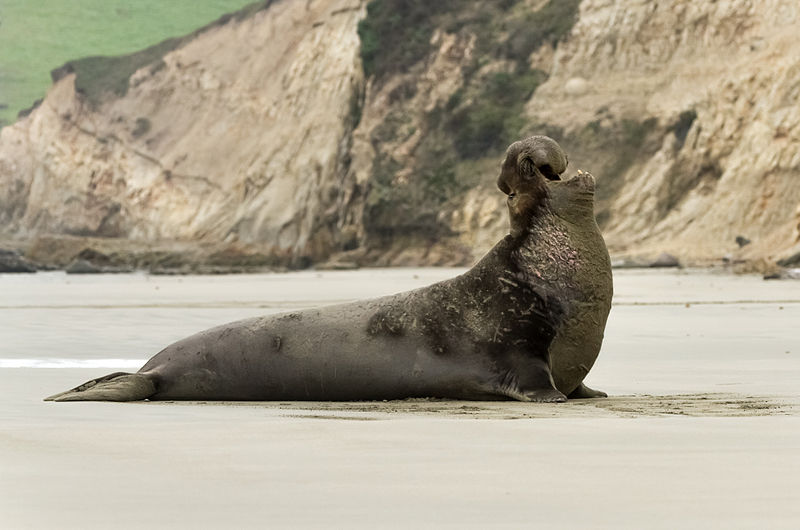
- Elephant seals are large earless seals which belongs to the genus Mirounga.[1]
- Northern elephant seals are sexually dimorphic meaning that the female exhibits different characteristics than the male.[2]
- Researchers analyzed a dataset on movement pattern, diving behavior, food hunting success, and mortality rate.
- The dataset was produced from monitoring the elephant seals over a period of almost 10 years.
- Females dive deep to hunt for food in open ocean habitat; however, males dive shallow to hunt food near the shores.
- Researchers observed that males gain six times more mass than females.
- They also found that males obtain energy about 4 times faster than females.
- These food hunting strategies and trade-offs are associated to various energy demands and life-history strategies.
- Life-history is the pattern of survival and reproduction, along with the traits that directly affect survival rate and reproductive success.[3]
- Males utilize food hunting strategies with a high mortality risk to achieve larger body size to compete for females.
- There is a small percentage of the largest males that successfully mate.
- Females utilize food hunting strategies with a low mortality risk to maximize reproductive success.
- The results suggest that mortality rates can be affected by sex-specific traits.
- Additionally, trade-offs between food hunting rewards and mortality risk can affect each sex’s ability to maximize fitness.
- In summary, males are willing to risk death to consume more food hoping they can successfully mate with the females.
Sources:
Kienle, S. S., Friedlaender, A. S., Crocker, D. E., Mehta, R. S., & Costa, D. P. (2022). Trade-offs between foraging reward and mortality risk drive sex-specific foraging strategies in sexually dimorphic northern elephant seals. Royal Society open science, 9 (1), 210522. https://doi.org/10.1098/rsos.210522
[1] https://en.wikipedia.org/wiki/Elephant_seal
[2] https://en.wikipedia.org/wiki/Sexual_dimorphism
[3] https://www.oxfordbibliographies.com/view/document/obo-9780199830060/obo-9780199830060-0016.xml
Advertisements
Advertisements
AI Disclosure Statement:
The Chromoscience uses AI-assisted tools to support the preparation and editing of science articles. Content is reviewed by the editor for clarity and consistency with the cited research before publication. Readers are encouraged to consult the original scientific publications for complete findings, methods, and limitations.



