

Advertisements
Advertisements
Related Topics

- Studies have shown that gut microbiota can regulate tumor responsiveness to chemotherapy or immunotherapy.
- However, the mechanism of this regulation is not clear.
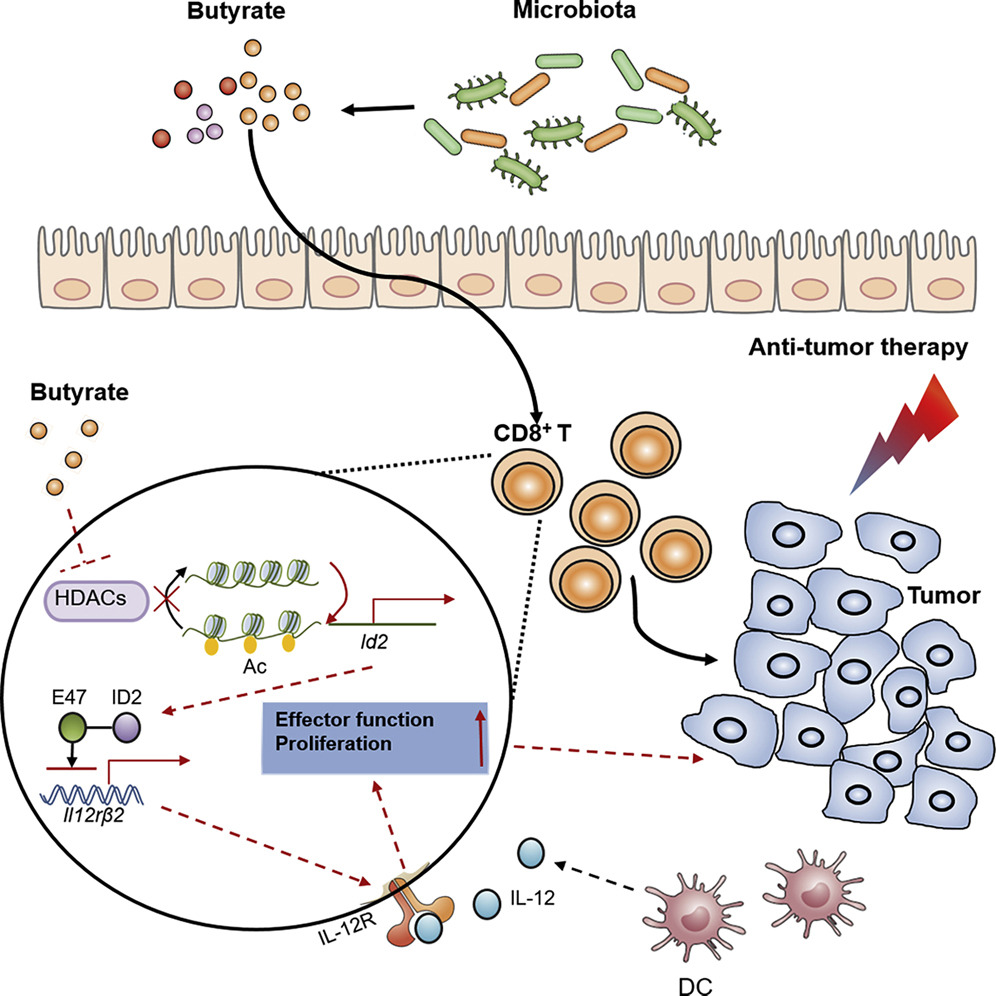
- Researchers found that metabolites from gut microbiota can increase the effectiveness of oxaliplatin by regulating CD8+ T cell function in the tumor microenvironment.
- Oxaliplatin is a drug used to treat colon and rectal cancer.[1]
- Butyrate is one of the metabolites produced by the gut microbiota.
- Butyrate treatment improved the antitumor responses of cytotoxic CD8+ T cell by promoting the IL-12 signaling pathway.
- IL-12 signaling pathway is associated with the activation of innate and adaptive immune responses.
- Cancer patients that responded to oxaliplatin showed higher level of serum butyrate.
- High level of serum butyrate can improve ID2 expression and CD8+ T cell function.
- The results suggest that butyrate produced by gut microbiota can improve antitumor responses of CD8+ T cells.
Sources:
He, Y., Fu, L., Li, Y., Wang, W., Gong, M., Zhang, J., Dong, X., Huang, J., Wang, Q., Mackay, C. R., Fu, Y. X., Chen, Y., & Guo, X. (2021). Gut microbial metabolites facilitate anticancer therapy efficacy by modulating cytotoxic CD8+ T cell immunity. Cell metabolism, S1550-4131(21)00109-1. Advance online publication. https://doi.org/10.1016/j.cmet.2021.03.002
[1] https://www.drugs.com/mtm/oxaliplatin.html
Advertisements
Advertisements
AI Disclosure Statement:
The Chromoscience uses AI-assisted tools to support the preparation and editing of science articles. Content is reviewed by the editor for clarity and consistency with the cited research before publication. Readers are encouraged to consult the original scientific publications for complete findings, methods, and limitations.



